Piping commodities are the essential components that make fluid transport possible in industries such as oil & gas, chemical plants, power generation, and water treatment. These commodities are generally divided into two groups:
- Bulk Items – Pipes, fittings, flanges, gaskets, and fasteners.
- Special Items – Strainers, corrosion coupons, hoses, sight glasses, injection quills, and more.
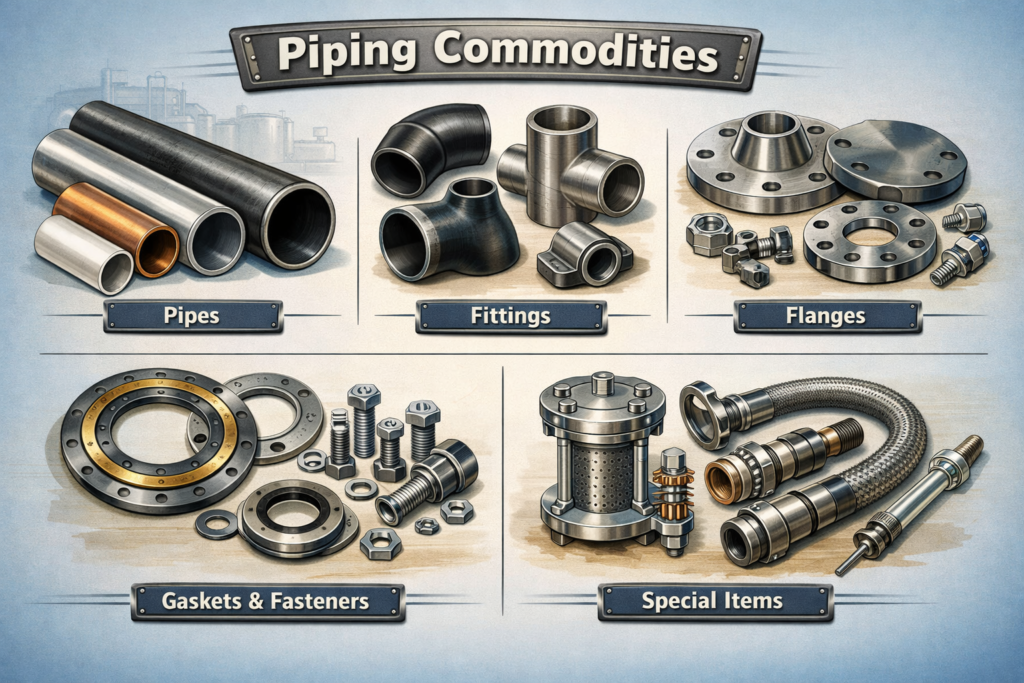
Each plays a unique role in ensuring safety, efficiency, and maintainability of piping systems.
1. Pipes
Pipes are hollow cylindrical elements designed to move liquids, gases, or steam between equipment.
- Materials: Carbon steel, stainless steel, alloys, PVC, HDPE.
- Applications: Process plants, water distribution, steam lines.
2. Fittings
Fittings connect pipes and allow changes in direction, size, or flow.
- Elbows: Redirect flow.
- Tees: Create branches.
- Reducers: Adjust diameter.
- Caps & Olets: Close ends or create branch connections.
3. Flanges
Flanges are mechanical connectors that make piping systems easier to assemble, disassemble, and maintain.
- Types: Weld neck, slip‑on, socket weld, blind.
- Ratings: ASME pressure classes (150#, 300#, 600#).
4. Gaskets & Fasteners
These ensure leak‑proof joints between flanges.
- Gaskets: Spiral wound, ring joint, PTFE.
- Fasteners: Bolts and nuts (ASTM A193 B7, A194 2H).
5. Special Items
Special commodities enhance performance and safety:
- Strainers: Remove debris from fluids.
- Corrosion Coupons: Monitor corrosion rates.
- Hoses & Couplings: Provide flexible connections.
- Sight Glasses: Allow visual inspection of flow.
- Injection Quills: Safely inject chemicals into pipelines.