🔹 What Are Pipes?
Pipes are one of the most widely used industrial components — visible in every home and facility. A pipe is a hollow cylindrical structure designed to transport fluids (liquids or gases) from one point to another.
In the oil and gas industry, pipe dimensions follow international standards:
- ASME B36.10 – for ferritic materials (carbon steel)
- ASME B36.19 – for austenitic materials (stainless steel)
🔹 Pipe Cross‑Section Explained
Below is a simple cross‑sectional diagram showing the key dimensions of a pipe:
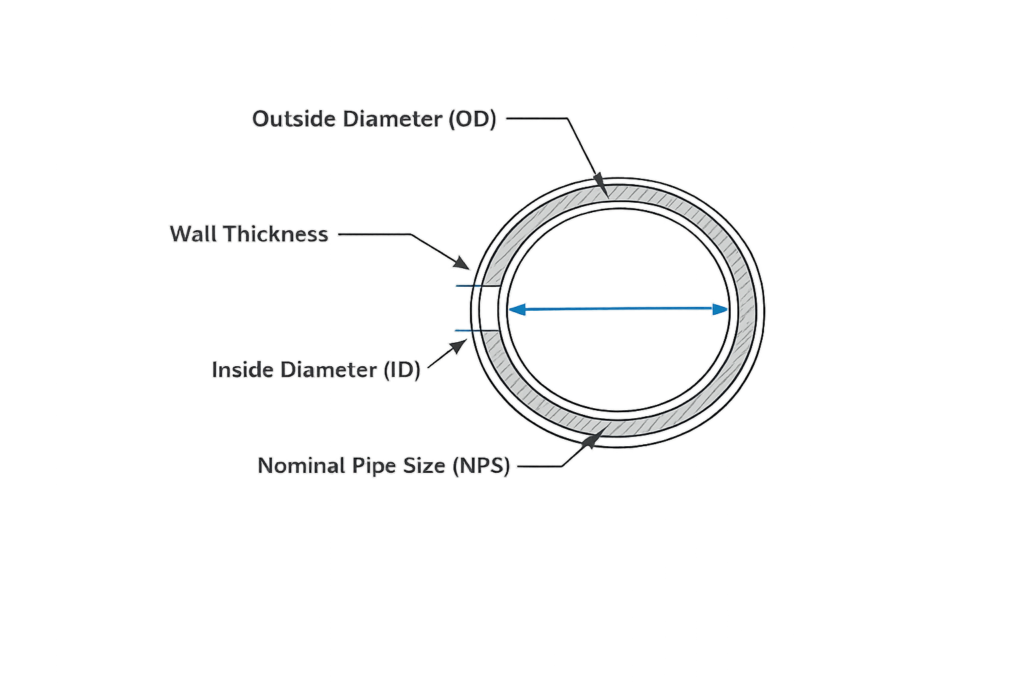
- Outside Diameter (OD)
- Inside Diameter (ID)
- Wall Thickness
- Nominal Pipe Size (NPS)
💡 Key Insight: The outside diameter (OD) of a pipe remains constant for a given nominal size. When the wall thickness increases, the inside diameter (ID) decreases — a fundamental concept in piping design and flow calculations.
🔹 Pipe Materials
Pipes are available in metallic and non‑metallic materials, each serving specific industrial needs.
⚙️ Metallic Pipes
Commonly used in oil and gas applications:
- Carbon Steel
- Stainless Steel
- Duplex Stainless Steel
- Super Duplex Stainless Steel
- Titanium
🌿 Non‑Metallic Pipes
Used in water systems, chemical plants, and corrosion‑resistant environments:
- GRP (Glass‑Reinforced Plastic)
- HDPE (High‑Density Polyethylene)
Design standards for non‑metallic pipes include:
- AWWA M45
- AWWA C950
🔹 Final Thoughts
Pipes are the lifelines of industrial systems, ensuring safe and efficient fluid transport. In upcoming posts, we’ll explore piping materials in detail — their properties, applications, and selection criteria.
💬 Have questions or insights? Share your thoughts in the comments below — let’s build a community of piping professionals at EngiPiping.com.